
Why Knowledge Workers Lose 11+ Hours a Week to Email
Knowledge workers lose 11+ hours a week to email, search, and app switching. See where the time goes and how one Franz workspace cuts the overhead.
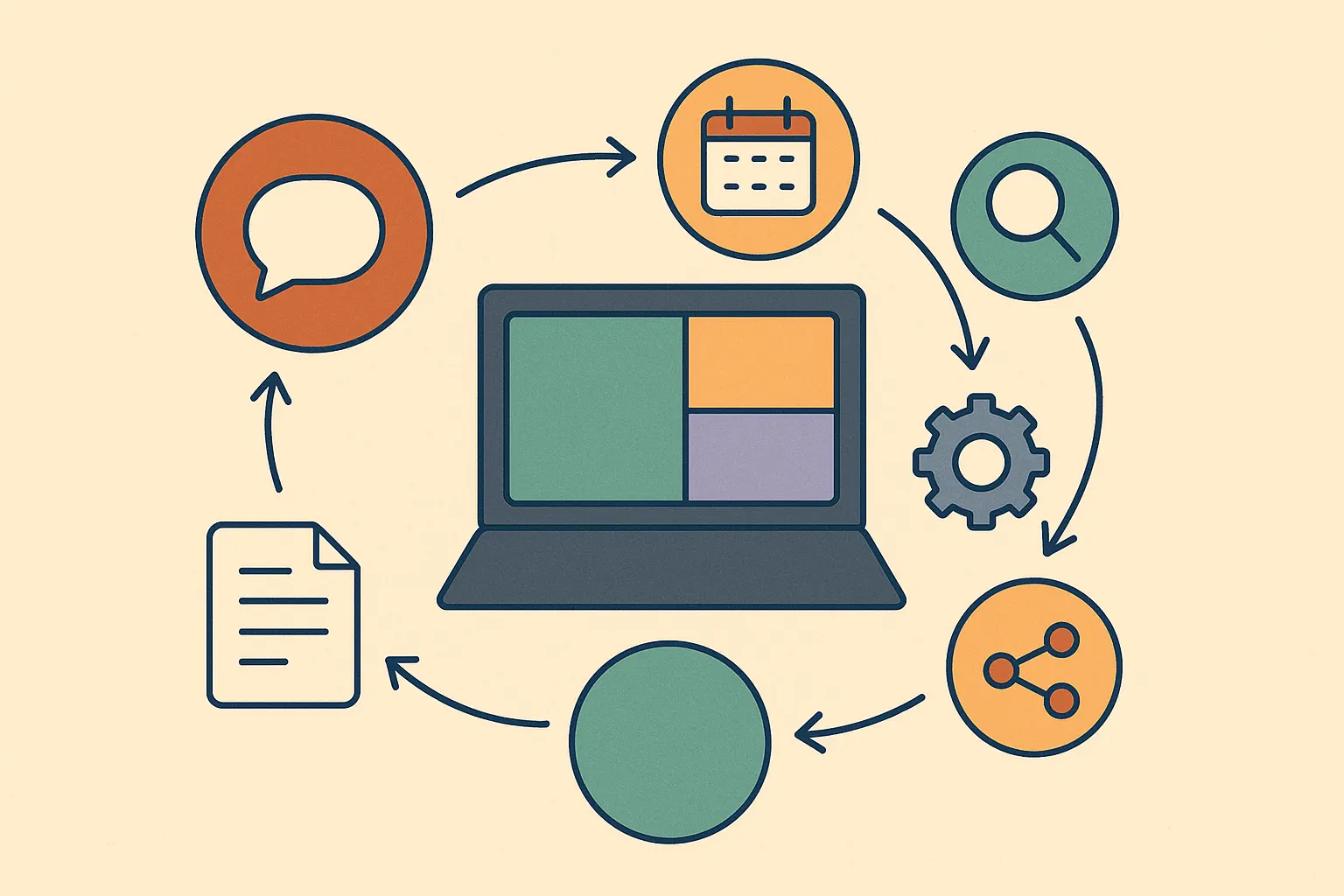
Knowledge workers lose more than 11 hours a week to email before the app-switching tax even starts. McKinsey's time-use breakdown puts only 39% of the workweek into role-specific work; the rest disappears into email, searching, internal coordination, and the context reset between tools.
That is the practical problem behind the messaging overload pillar. The cost is not one loud notification. It is the full system of inboxes, tabs, and recovery work that turns a quick check into another loop through Slack, WhatsApp, Signal, and email.
What they studied
McKinsey Global Institute tracked where knowledge workers actually spend their hours. Not estimates. Real time logs, across industries, broken down by task. They mapped a full workweek to find the exact cost of communication overhead.
What they found
McKinsey's time-use breakdown shows how much of the week disappears into communication overhead.
More time goes to managing communication than doing the job.
What it means for you
Big companies have a support layer: assistants, ops people, coordinators who absorb the load. You don't.
Every message, you handle yourself. Every app switch, you make yourself. Every notification pulls you away from focused work, and costs you directly.
The McKinsey numbers describe a corporate worker. For solo operators and small teams, it's often worse. You're not just the maker. You're also the inbox manager, the person who checks five apps before knowing what's actually happening today. That is the same pattern behind communication habits that protect deep work.
Here's the point: communication isn't the problem. Scattered communication is.
Your team messages in Slack. Clients message you in email. Partners on WhatsApp. Community in Discord. That's not a communication system. It's four separate inboxes running in parallel. Each one demands its own login, its own mental model, its own notification routine.
That's where the time goes. Not in the messages themselves. In the switching. In the three tabs you open to answer one question. In the mental reset every time you change context.
The practical fix
Put all your services in one place: same window, same sidebar, same notification system. The switching cost drops to almost nothing. You read the Slack message and the WhatsApp message in the same motion. You never lose context because you never left. The 1,100 daily app switches collapse into one. Start by adding Slack, WhatsApp, Signal, and email to one Franz window, then use communication patterns that protect deep work to keep the window from becoming another always-on inbox.
That's where the time comes back. Not from fewer messages. Not from communication policies. Just from stopping the fragmentation that turns fast tools into slow work.
Eleven hours a week on email. Nineteen percent on searching for things you already have somewhere. None of it is inevitable. It's what happens when your tools don't work together. McKinsey's social economy research made the same point. The value of collaboration tools depends entirely on how you deploy them. Most teams just added more tools without integrating them, and paid for it with their time.
- knowledge work
- app switching
- email overload
- focus time
- productivity research
Related reading
5 Communication Patterns That Protect Deep Work
Protect deep work with five communication habits: scheduled message blocks, clearer asks, channel fit, predictable replies, and faster loop closing.
10 Apps That Cut Your Team's Daily Coordination Tax
Small teams lose hours when work scatters across too many apps. Build a focused stack that cuts checking, handoffs, app overlap, and coordination drag.

Add Slack, WhatsApp, and Signal to One Window
Add Slack, WhatsApp, Signal, email, and more to one Franz window so every account stays signed in, separated, and reachable from one sidebar.