
The Secret to Team Intelligence Is Listening, Not IQ
MIT research shows team intelligence depends less on individual IQ than on turn-taking, listening, and social sensitivity in everyday communication.
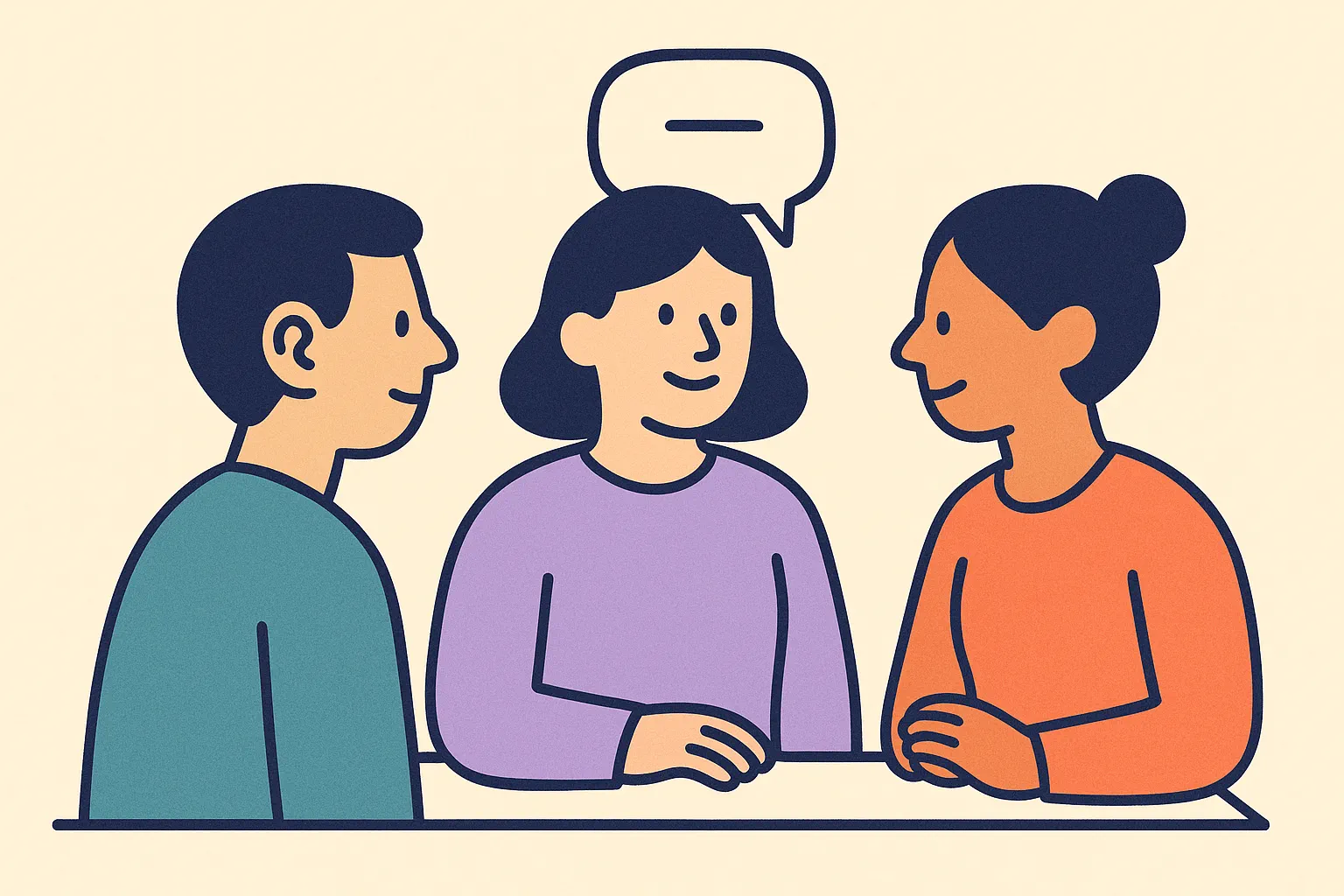
Group intelligence depends less on individual IQ and more on whether people take turns and listen. MIT researchers proved it.
For small teams, listening is not separate from operations. It belongs inside the same solo and small-team work system as message habits, shared tools, and clear handoffs.
What they studied
MIT and Carnegie Mellon ran two experiments on 192 small groups (699 people, in teams of two to five). Tasks ranged on purpose: brainstorming, visual puzzles, moral judgments, negotiations, planning 1. The question was simple. Does a group have its own intelligence, separate from the IQs of its members? It does.
A 2021 pooled re-analysis of 22 studies (1,356 groups, 5,279 participants) confirmed the same pattern at much larger scale 2.
What they found
Groups have their own intelligence score. A single "collective intelligence" factor (the c factor) predicted how well a team did across the whole task set, not just on one type of problem 1. Some teams are broadly smarter than others, the same way some individuals are.
The common thread wasn't raw IQ. It was how well people listened and took turns.
Individual IQ was not the strongest predictor. Adding up IQ scores didn't explain group performance. Neither did finding the smartest person in the room 1. Collective performance was its own thing.
Social sensitivity drove the score. The biggest predictor was how well members read each other. Researchers measured it with the Reading the Mind in the Eyes test: 36 photos of the eye region, each scored by picking the best of four mental-state words 3. Teams that did well on this test outperformed teams that didn't 1.
Turn-taking mattered more than talent. In high-scoring groups, conversation distributed across members. In low-scoring groups, one or two voices dominated. Results dropped, even when those people were individually sharp 1. The 2021 replication showed the same effect held across far more diverse settings 2.
Distance changes nothing. A follow-up study put teams in text-only online environments. No faces, no tone, no body language. The same eye-reading score still predicted collective intelligence 4. The signal that matters isn't visual. It's the underlying ability to model what someone else is thinking.
What it means for you
Collective intelligence explains the gap. And you can close it. The practical companion is a set of communication patterns that protect deep work, because listening fails fastest when every thread is fragmented.
Stop letting one voice fill the room. When one person drives every conversation, everyone else stops processing. The team loses signal, even when the people are smart. Ask questions before you share your own view. Pull quieter people in. Keep threads short enough that a reply doesn't feel like a wall to climb.
Make social sensitivity a team habit, not a personal quirk. High-performing teams stay attuned to how people actually feel, not just what they say 5. Read the tone of a message before you reply. Notice when someone goes quiet. Check in before a decision lands.
Distributed teams lose signal
Communication quality is a performance lever. When client threads split across email, WhatsApp, Signal, and Slack, context gets lost. You answer the words without the story behind them. When conversations feel like status updates instead of real dialogue, collective intelligence breaks down. Not because people aren't capable. Because the structure won't let them think together.
When all of that lives in one workspace, the full story is there before you reply. “Clearer conversations aren't a soft skill. They're how small teams stop missing the work that matters.”
The smartest move isn't thinking harder. It's listening better. Franz keeps every thread in one workspace so you don't miss the cues that decide the project. If the tools themselves are creating the noise, audit the daily coordination stack next.
Based on Woolley et al., "Evidence for a Collective Intelligence Factor in the Performance of Human Groups" (Science, 2010).
- collective intelligence
- team listening
- group performance
- active listening
- small teams
Related reading
5 Communication Patterns That Protect Deep Work
Protect deep work with five communication habits: scheduled message blocks, clearer asks, channel fit, predictable replies, and faster loop closing.
10 Apps That Cut Your Team's Daily Coordination Tax
Small teams lose hours when work scatters across too many apps. Build a focused stack that cuts checking, handoffs, app overlap, and coordination drag.
Why Knowledge Workers Lose 11+ Hours a Week to Email
Knowledge workers lose 11+ hours a week to email, search, and app switching. See where the time goes and how one Franz workspace cuts the overhead.
Sources
- 1. Evidence for a Collective Intelligence Factor in the Performance of Human Groups · Science · 2010-10-29 ↗
- 2. Quantifying collective intelligence in human groups · Proceedings of the National Academy of Sciences · 2021-05-25 ↗
- 3. The 'Reading the Mind in the Eyes' Test Revised Version: A Study with Normal Adults, and Adults with Asperger Syndrome or High-functioning Autism · Journal of Child Psychology and Psychiatry · 2001-02-01 ↗
- 4. Reading the Mind in the Eyes or Reading between the Lines? Theory of Mind Predicts Collective Intelligence Equally Well Online and Face-To-Face · PLOS ONE · 2014-12-16 ↗
- 5. Defend Your Research: What Makes a Team Smarter? More Women · Harvard Business Review · 2011-06-01 ↗